
Article Plan: Back to Back Drawing Activity PDF
This comprehensive guide details a fun, printable activity – back-to-back drawing – fostering communication, teamwork, and creative thinking for various age groups and settings.
Back-to-back drawing is a remarkably simple yet profoundly effective communication exercise. It involves two participants seated back-to-back, one with an image and the other with drawing materials. The image-holder (the ‘Direction-Giver’) must verbally guide the drawer in recreating the picture without revealing what it is.
This activity isn’t just about artistic skill; it’s a powerful tool for observing and improving how individuals convey and interpret information. Perfect for therapy, education, and team-building, it highlights the challenges of clear communication and the importance of active listening. Printable worksheets readily available enhance accessibility and structure for this engaging exercise.
What is the Back to Back Drawing Activity?
The back-to-back drawing activity is a collaborative exercise designed to assess and enhance communication skills. Participants work in pairs, positioned so they cannot see each other’s work. One partner receives a visual stimulus – a simple drawing or shape – and must describe it to their partner, who attempts to replicate it solely based on the verbal instructions.
Utilizing a back-to-back drawing worksheet PDF streamlines the process, providing pre-designed images and potentially structured observation forms. The core principle lies in the challenge of translating visual information into precise language and interpreting that language accurately, revealing communication strengths and weaknesses.
Benefits of the Activity
The back-to-back drawing activity offers a multitude of benefits, extending beyond simple entertainment. It’s a powerful tool for improving communication, demanding clear and concise instruction-giving and active listening. Utilizing a back-to-back drawing worksheet PDF enhances focus and provides a tangible outcome for assessment.
Furthermore, the activity fosters teamwork and collaboration, requiring partners to work together towards a shared goal. It also stimulates creative thinking, as both the describer and the drawer must problem-solve and adapt. This exercise is valuable for diverse groups, promoting understanding and shared experiences.
Improved Communication Skills
The core benefit of the back-to-back drawing activity lies in its ability to hone communication skills. Participants are forced to rely on verbal cues alone, eliminating visual aids. This necessitates precise language and active listening to accurately convey and interpret instructions. A back-to-back drawing worksheet PDF provides a structured framework for this practice.
The activity highlights the importance of clarity, conciseness, and feedback. Direction-givers learn to articulate descriptions effectively, while drawers develop skills in seeking clarification. Miscommunication inevitably arises, offering valuable learning opportunities to refine communication strategies and build understanding.
Enhanced Teamwork and Collaboration
Back-to-back drawing inherently demands teamwork and collaborative effort. Success isn’t achieved individually; it relies on the synchronized efforts of both the direction-giver and the drawer. Utilizing a back-to-back drawing worksheet PDF sets the stage for this cooperative dynamic. Participants must trust each other and work together towards a shared goal – recreating the image.
The activity fosters a sense of shared responsibility and mutual reliance. It demonstrates how effective collaboration requires clear roles, active participation, and a willingness to adapt based on feedback. This builds stronger interpersonal connections and promotes a positive team environment.
Creative Thinking Development
The back-to-back drawing activity, often facilitated with a readily available PDF worksheet, isn’t just about replication; it sparks creative problem-solving. The direction-giver must creatively translate a visual into verbal instructions, while the drawer interprets those instructions and translates them into a visual form.
This process encourages both participants to think outside the box, adapting to limitations in communication and finding innovative ways to convey and understand information. It promotes flexible thinking and the ability to approach challenges from different perspectives, enhancing overall creative capacity.
Target Audience & Age Groups
The beauty of the back-to-back drawing activity, easily implemented with a downloadable PDF, lies in its adaptability. It’s particularly effective for Pre-K, Kindergarten, and first-grade students, fostering early writing skills, family awareness, and fine motor development. However, its benefits extend far beyond early childhood.
The activity is valuable for therapy clients of all ages, teams seeking to improve collaboration, and anyone wanting to enhance communication skills. Adjusting image complexity allows tailoring the activity to diverse cognitive abilities and developmental stages, making it universally applicable.
Pre-K and Kindergarten Applications
For younger learners, utilizing a simple back-to-back drawing worksheet PDF focuses on foundational skills. The activity promotes early writing through tracing or writing about family, alongside drawing family members. It’s a fantastic way to encourage expressing personal details meaningfully, building self-awareness and communication.
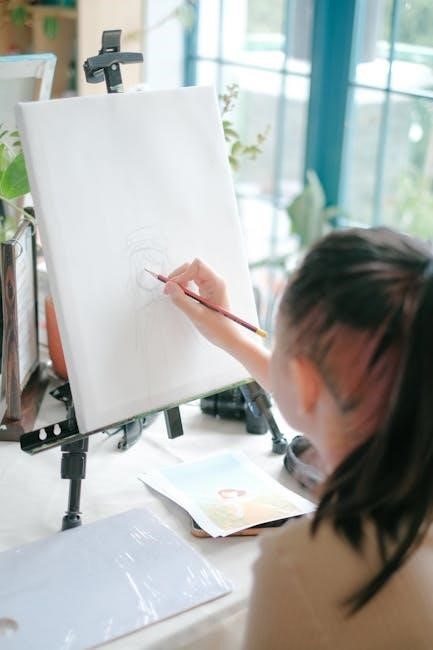
Keep images straightforward – basic shapes or easily recognizable objects. This builds confidence and minimizes frustration. The exercise supports fine motor development as children practice drawing. It also fosters family awareness, prompting conversations about loved ones and their roles.
First Grade and Beyond

As students progress, the back-to-back drawing activity PDF can be adapted for increased complexity. Introduce more detailed images for the direction-giver to describe, challenging both verbal and listening skills. Encourage descriptive language beyond basic shapes and colors – focusing on spatial relationships and specific features.
This builds upon foundational communication skills, promoting concise and accurate instruction-giving. Variations like time limits or specific constraints (e.g., only using certain colors) can add an extra layer of challenge. The activity remains valuable for reinforcing teamwork and creative problem-solving in older students.
Materials Needed for the Activity
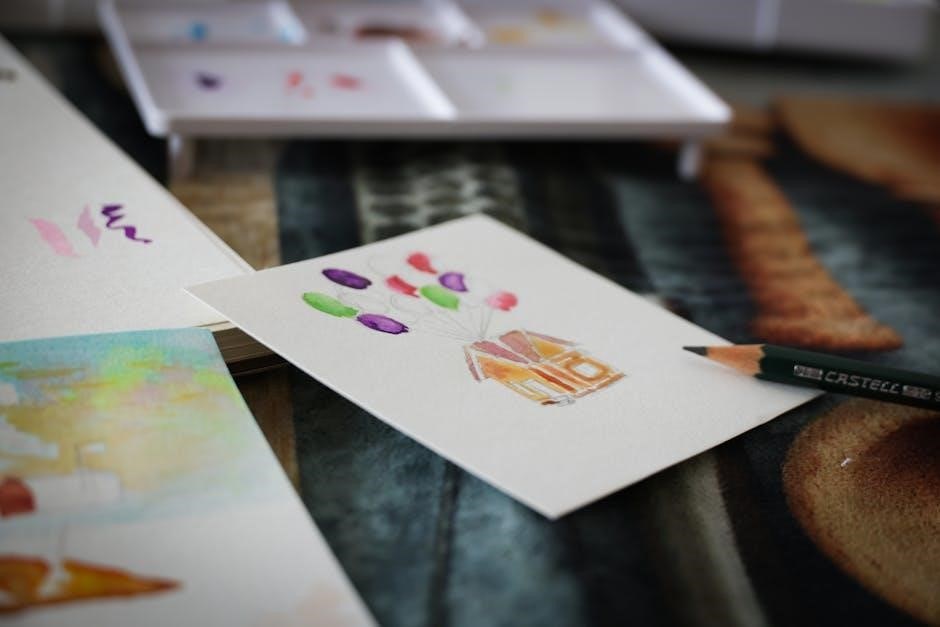
To effectively conduct the back-to-back drawing activity, a few simple materials are required. Primarily, you’ll need a back to back drawing worksheet PDF – readily available online for free or purchase. Each pair of participants will need two sheets of blank paper, ensuring the ‘drawer’ has space to create their image.
Pencils are essential, though colored pencils or crayons can enhance the creative aspect. Optionally, a selection of simple line-drawn images for the direction-givers adds variety. Consider having clipboards available for easier drawing if participants are seated without tables.
Back to Back Drawing Worksheet PDF – Availability
Numerous resources offer back to back drawing worksheet PDFs, catering to diverse needs and budgets. Therapist Aid provides a readily accessible version, designed specifically for therapeutic settings, focusing on communication exercises. Mentalycs also offers worksheets, highlighting improved communication and creative thinking benefits.
Free printable options are widely available through various educational websites and search engines. Alternatively, commercial worksheets with more complex designs or themed images can be purchased online. The choice depends on the target audience, desired complexity, and specific learning objectives.
Free Printable Resources
A wealth of free back-to-back drawing worksheets are easily accessible online, making this activity incredibly affordable. A quick internet search reveals numerous options suitable for various age groups and skill levels. Many educational blogs and websites offer downloadable PDFs, often including simple line drawings ideal for beginners.
These resources frequently focus on basic shapes and objects, perfect for Pre-K and Kindergarten students. Utilizing these free printables allows educators and therapists to implement the activity without financial constraints, promoting communication and teamwork effectively.
Commercial Worksheet Options
While numerous free resources exist, commercially available back-to-back drawing worksheets offer expanded options and often higher production quality. Platforms like Therapist Aid and Mentalycs provide professionally designed materials, frequently including multiple image sets with varying complexity.
These paid resources often incorporate structured instructions and assessment guidelines, beneficial for therapeutic settings or formal educational environments. Commercial options may also feature themed worksheets, catering to specific interests or learning objectives, enhancing engagement and providing a more polished experience.

Step-by-Step Guide to Conducting the Activity
Begin by dividing participants into pairs and instructing them to sit back-to-back, ensuring no visual contact. One participant becomes the ‘Direction-Giver’ and receives a pre-selected image. The other is the ‘Drawer’.
The Direction-Giver must verbally guide the Drawer to recreate the image without revealing what they are describing – only how to draw it. Encourage clear, concise instructions focusing on shapes, lines, and spatial relationships. Observe interactions, noting communication effectiveness and potential roadblocks. This process fosters active listening and descriptive language skills.
Pairing Participants
Strategic pairing is crucial for a successful back-to-back drawing experience. Consider mixing skill levels – pairing a confident communicator with someone who is more reserved can encourage participation. Avoid pairing individuals with pre-existing strong dynamics, as this might overshadow the activity’s goals.
Random assignment can also be effective, promoting interaction with new peers. Ensure each pair has adequate space and materials. Briefly explain the activity’s purpose – to enhance communication and teamwork – before initiating the pairing process. A well-considered pairing sets the stage for productive collaboration.
Role Assignment: Direction-Giver and Drawer
Clearly defining roles is essential: one participant becomes the “Direction-Giver,” and the other, the “Drawer.” The Direction-Giver possesses the image and must verbally guide the Drawer in recreating it without revealing what they are drawing. The Drawer relies solely on the verbal instructions, asking clarifying questions as needed.
Rotating roles after the first round is highly recommended, allowing both individuals to experience both perspectives. This fosters a deeper understanding of the communication challenges involved. Emphasize that the Direction-Giver should avoid using the object’s name; descriptive instructions are key.
Giving Instructions – Best Practices
Effective instruction is paramount for success. Direction-Givers should use precise language, focusing on shapes, sizes, and spatial relationships – “Draw a large circle,” rather than “Draw the head.” Avoid referencing the object itself! Encourage breaking down complex images into smaller, manageable steps.
Patience is crucial; the Drawer will likely need clarification. Direction-Givers should respond to questions calmly and provide further detail. Discourage vague terms like “over there” and promote specific directions like “two inches to the right.” Active listening from both sides ensures a smoother, more productive experience.
Simple Image Selection for Direction-Givers
Begin with uncomplicated images for optimal learning. Ideal choices include basic geometric shapes – squares, triangles, circles – or simple, line-drawn objects like a house, a tree, or a flower. Avoid intricate designs or images with numerous small details initially.
Gradual progression is key. As pairs demonstrate success, introduce slightly more complex images. The goal is to challenge communication skills without overwhelming the Drawer. Printable worksheets often provide a range of images suited for varying skill levels, ensuring a positive and engaging experience for all participants.
Variations and Extensions of the Activity
Increase the challenge by introducing time limits, prompting quicker thinking and clearer communication. Another extension involves increasing the complexity of the images, moving beyond simple shapes to more detailed scenes or abstract designs.
Consider adding constraints, such as limiting the number of questions the Direction-Giver can ask, or requiring specific descriptive words. Worksheets can incorporate themed drawing prompts – “draw a fantastical creature” – to spark creativity. These variations enhance problem-solving skills and adaptability within the collaborative process.
Increasing Complexity of Images
Gradually introduce more intricate images to challenge both the Direction-Giver and the Drawer. Start with basic geometric shapes, then progress to simple objects, and eventually move towards scenes with multiple elements. This escalation demands more precise language and attentive listening.
Abstract concepts or designs can further test communication skills, requiring detailed descriptions beyond simple visual recognition. Utilizing worksheets with varying difficulty levels allows for tailored experiences. Remember to observe how participants adapt their strategies as the images become more challenging, fostering growth in both areas.
Time Limits and Challenges
Introduce time constraints to heighten the pressure and encourage efficient communication. Start with a generous timeframe, then gradually reduce it to observe how pairs adapt. This simulates real-world scenarios demanding quick, clear instructions.
Add challenges like limiting the number of questions allowed or prohibiting specific descriptive words. These constraints force participants to be more resourceful and precise in their language. Consider a “no repeating” rule for instructions. Observe how these limitations impact the final drawings and the communication dynamic, revealing areas for improvement.
Assessment and Reflection
Observe communication patterns during the activity. Note how frequently the drawer asks for clarification, the types of questions asked, and the tone of voice used by both participants. Pay attention to non-verbal cues, like frustration or hesitation.
Debriefing is crucial. Facilitate a discussion about the experience, asking pairs what worked well, what was challenging, and how they could improve their communication. Encourage reflection on the impact of clear instructions and active listening. This post-activity analysis solidifies learning and promotes self-awareness.
Observing Communication Patterns
Careful observation reveals key insights. Note if the ‘Direction-Giver’ provides overly complex instructions or struggles with descriptive language. Does the ‘Drawer’ interrupt, make assumptions, or actively seek clarification? Observe the frequency of requests for repetition or rephrasing.
Analyze the communication style – is it direct, indirect, patient, or frustrated? Look for patterns in how each role handles ambiguity. These observations provide valuable data on individual communication strengths and areas for improvement, highlighting the need for concise and clear messaging.
Debriefing and Discussion Points

Facilitate a post-activity discussion. Ask participants about their experiences – what felt easy, what was challenging? Explore the frustrations encountered by both roles. Discuss the importance of active listening and clear articulation.
Encourage reflection on how communication breakdowns impacted the final drawing. Did assumptions lead to errors? How could instructions have been improved? Connect the activity to real-life scenarios where effective communication is crucial, emphasizing the value of patience and seeking clarification for successful outcomes.
Potential Challenges and Solutions
Miscommunication is a primary challenge; encourage the ‘Direction-Giver’ to use precise language, avoiding ambiguous terms like “a little to the left.” If frustration arises, suggest taking a brief pause or simplifying the image.
Adapt for diverse learning styles by allowing verbal checks for understanding. For participants struggling with direction-giving, offer sentence starters. Address potential power imbalances by rotating roles. Ensure a supportive environment where mistakes are viewed as learning opportunities, fostering open communication and collaborative problem-solving.
Managing Miscommunication

Miscommunication is inevitable in this activity, presenting a valuable learning opportunity. Encourage ‘Direction-Givers’ to solicit feedback – “Does that make sense?” – and ‘Drawers’ to ask clarifying questions.

Implement a ‘no guessing’ rule; drawers should only draw based on explicit instructions. If significant discrepancies occur, pause, review the instructions, and restart. Frame errors as chances to refine communication strategies. Emphasize active listening and precise articulation to minimize misunderstandings and maximize the activity’s benefits.
Adapting for Different Learning Styles
Visual learners benefit from the drawing aspect itself, while auditory learners thrive on the verbal exchange. For kinesthetic learners, consider allowing brief physical demonstrations of shapes or lines (without revealing the image, of course!).
Provide alternative communication methods for those who struggle verbally – perhaps written keywords or simple gestures. Adjust image complexity based on individual skill levels. Offer varied roles; let participants switch between ‘Drawer’ and ‘Direction-Giver’ to cater to diverse preferences and enhance overall engagement.
Resources and Further Information
Therapist Aid offers a readily available “Back to Back Drawing” exercise with clear instructions and a printable worksheet, ideal for therapeutic settings. Mentalycs Worksheets provide a focused back-to-back activity, emphasizing improved communication and creative problem-solving.
Explore online resources for additional image prompts and variations. Consider searching for “communication games for kids” or “team building activities” for related exercises. Remember to adapt materials to suit the specific needs and age group of your participants, ensuring a positive and productive experience.
Therapist Aid Resources
Therapist Aid provides a valuable, free resource: a downloadable “Back to Back Drawing” exercise. This includes a six-page document with detailed instructions for facilitators and participants; The worksheet is designed to enhance communication skills through a simple, engaging activity.
The resource specifically guides pairing participants, assigning roles (direction-giver and drawer), and facilitating effective instruction. It’s a readily accessible tool for therapists and educators seeking to improve collaborative abilities and verbal clarity within groups. Find it at TherapistAid.com for immediate use.
Mentalycs Worksheets

Mentalycs offers a “Back-to-Back Activity Worksheet” designed to boost communication and teamwork. This resource blends artistic expression with logical thinking, appealing to diverse learners. The worksheet focuses on improving concise communication as participants rely on clear instructions for successful drawing.
Benefits include enhanced early writing skills, family awareness, creative thinking, and fine motor development. It’s suitable for various applications – morning work, early finishers, homework, or calming activities; Mentalycs worksheets provide a structured approach to this engaging exercise, fostering collaboration and skill-building.